
Resources · Swimming
Shoulder pain in swimmers usually starts in the mid-back
It shows up around the catch. Fine for the first few hundred meters, then not. You drop your volume, it settles. You build back up, it returns at the same point. The pain is in the shoulder. The problem often isn't.
“I picked up my daughter and my neck went numb”
— Monique, 4 weeks of 7/10 neck painYour results may vary.
 Play video: Client testimonial: Monique, 4 weeks of neck pain rated 7/10
 “I tried a new move in yoga. I woke up the next morning and couldn't move my neck”
— Danielle, 6 weeks of 7/10 neck painYour results may vary.
 Play video: Client testimonial: Danielle, 6 weeks of neck pain rated 7/10
 “After 3 years I didn't think anyone could help me fix my neck”
— Sandy, 3 years of 8/10 neck painYour results may vary.
 Play video: Client testimonial: Sandy, 3 years of neck pain rated 8/10
 “My office job means my neck is in constant pain, nothing seems to help”
— Natasha, 4 weeks of 7/10 neck painYour results may vary.
 Play video: Client testimonial: Natasha, 4 weeks of neck pain rated 7/10
 “It's too hard to get in shape when I've had knee pain ever since I can remember”
— Cindy, a lifetime of 6/10 knee painYour results may vary.
 Play video: Client testimonial: Cindy, a lifetime of knee pain rated 6/10
 “I tore my ACL in an MMA match and haven't been able to train since”
— Meghan, 4/10 knee pain after an ACL tearYour results may vary.
 Play video: Client testimonial: Meghan, knee pain after an ACL tear, 4 out of 10 down to 0
 “After my fall my knee was in pain and I couldn't stand on one leg”
— Brad, 6 months of 6/10 knee painYour results may vary.
 Play video: Client testimonial: Brad, 6 months of knee pain rated 6/10
 “I got surgery on my shoulder 2 years ago and have been getting rolfing and PT”
— Samantha, 5 years of 7/10 shoulder painYour results may vary.
 Play video: Client testimonial: Samantha, 5 years of shoulder pain rated 7/10
 “My shoulder numbness and tingling was so bad I drove 2 hours to see Jamie Atlas”
— Heather, 6 weeks of 10/10 shoulder nerve painYour results may vary.
 Play video: Client testimonial: Heather, 6 weeks of shoulder nerve pain rated 10/10
 “I've been in physical therapy for 6 months and I'm stalled on my results”
— Judy, 6 months of 10/10 shoulder painYour results may vary.
 Play video: Client testimonial: Judy, 6 months of shoulder pain rated 10/10
 “My shoulder pain meant I couldn't take my shirt on or off without hurting”
— Sharon, 4 months of 6/10 shoulder painYour results may vary.
 Play video: Client testimonial: Sharon, 4 months of shoulder pain rated 6/10
 “3 surgeries over 10 years and I still can't get my shoulder above my head”
— Clay, 10 years of 7/10 shoulder painYour results may vary.
 Play video: Client testimonial: Clay, 10 years of shoulder pain rated 7/10
 “Taking my dog for a walk he pulled on my shoulder and now it hurts to move”
— Kendall, 2 weeks of 6/10 shoulder painYour results may vary.
 Play video: Client testimonial: Kendall, 2 weeks of shoulder pain rated 6/10
 “I was squatting at the gym when I felt a pop and my leg went numb”
— Kelly, 12 months of 8/10 back painYour results may vary.
 Play video: Client testimonial: Kelly, 12 months of back pain rated 8/10
 “After the car accident the hospital said I was fine but my back pain says otherwise”
— Dax, 5 days of 10/10 back painYour results may vary.
 Play video: Client testimonial: Dax, 5 days of back pain rated 10/10
 “Playing football has left me with constant back pain that I can't get rid of”
— Matthew, 7 weeks of 7/10 back painYour results may vary.
 Play video: Client testimonial: Matthew, 7 weeks of back pain rated 7/10
 “I went to Pilates to fix my back but it ended up making it worse”
— Colleen, 8 weeks of 7/10 back painYour results may vary.
 Play video: Client testimonial: Colleen, 8 weeks of back pain rated 7/10
 “I was thrown from a horse and couldn't bend over without pain”
— Katrina, 4 weeks of 6/10 back painYour results may vary.
 Play video: Client testimonial: Katrina, 4 weeks of back pain rated 6/10
 “This 9/10 back pain is stopping me from sleeping at night”
— Alexis, 2 months of 10/10 back painYour results may vary.
 Play video: Client testimonial: Alexis, 2 months of back pain rated 10/10
 “My back pain is so bad I can't put on my shoes”
— Penelope, 5 weeks of 7/10 back painYour results may vary.
 Play video: Client testimonial: Penelope, 5 weeks of back pain rated 7/10
 “Living with back pain has me living at a 7/10 pain that I can't find relief from”
— Chris, 8 weeks of 7/10 back painYour results may vary.
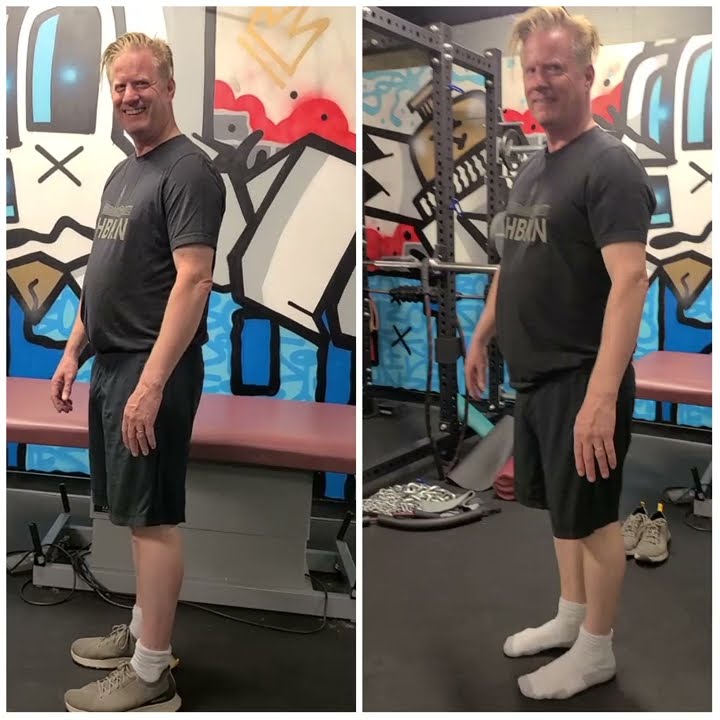 Play video: Client testimonial: Chris, 8 weeks of back pain rated 7/10
 “I have a herniated L4/L5 and my sciatic pain feels like a screwdriver in my back”
— Kendra, 2 years of shooting sciatic painYour results may vary.
 Play video: Client testimonial: Kendra, two years of shooting sciatic pain resolved
 “The doctor told me my spondylolisthesis back pain could only be cured with surgery”
— Tony, 2 weeks of lightning-bolt back painYour results may vary.
 Play video: Client testimonial: Tony, two weeks of severe back pain down to 1 out of 10
 The shoulder blade moves on the ribcage
Raise your arm overhead. Roughly a third of that motion happens at the shoulder joint itself. The rest comes from the shoulder blade rotating upward across the back of the ribcage — and the ribcage has to be able to extend and rotate for it to do that.
Which means your overhead range depends on the mobility of your mid-back: a region that spends most of the modern day flexed forward over a desk or a steering wheel. If that describes your working hours, the desk posture article is the other half of this story.
Stiffen the mid-back and the shoulder blade can't rotate as far. But the arm still has to get overhead — thousands of times per session. The remaining range gets taken from the shoulder joint, which reaches the end of its own range early and starts compressing the structures inside it. The rotator cuff is what gets irritated. Mid-back stiffness is often what put it in that position.
Why the usual approach stalls
Rest calms it down, because rest removes the repetition. Then you return to the same volume with the same mid-back and the same shoulder blade mechanics, and it comes back on schedule.
Cuff strengthening helps some people, and it isn't wrong — a stronger cuff tolerates more. But strengthening a muscle that's being pinched at end range doesn't address why it's arriving at end range so early. The order that tends to work: restore the mid-back and shoulder blade motion first, then build strength into the range you just got back, then rebuild volume. The non-aggravating shoulder work covers that middle step in detail.
Test your overhead range honestly
Lie on your back, knees bent, low back flat to the floor. Keep it flat — this is the whole test. Now reach both arms overhead toward the floor behind you.
If your arms reach the floor with the low back still flat, your overhead range is genuinely available. If your ribs lift and your back arches to get there, you don't have the range — you have a substitution. And that substitution is exactly what you're doing in the water, thirty times a minute.
What to work on. Mid-back extension and rotation first: rotation drills on your side, extension over a foam roller at the mid-back, and an overhead reach that lengthens one side of the body at a time so the shoulder blade integrates with the ribcage rather than working in isolation. Then load it — overhead work in the new range, starting light, because range without strength doesn't hold. Then technique: a crossover entry, a dropped elbow in the catch, or breathing exclusively to one side will keep reproducing the problem no matter what your mid-back does. Worth getting a set filmed.
When to stop self-managing
Night pain, weakness rather than pain, an inability to lift the arm at all, or shoulder pain persisting past six weeks of sensible modification all warrant a proper assessment. So does any shoulder that has previously dislocated or been surgically repaired — the rules for those are different and generic advice doesn't serve them.
If you've been cleared post-surgery but nobody has actually tested whether your shoulder tolerates a full session's volume, that gap between cleared and ready is a real and specific thing — and it is assessable. That is most of what this studio does. More on the shoulder pain page.
Common questions
Why does my shoulder only hurt after a few hundred meters?
Because the problem is cumulative, not structural in the way people assume. If your mid-back is stiff, your shoulder blade cannot rotate as far, and the remaining range gets taken from the shoulder joint itself. Early in a session there is enough tolerance to absorb that. After a few hundred repetitions there is not, and the structures inside the joint start to complain. The pain arriving at a predictable point in the session is a strong clue that mechanics, not tissue damage, is driving it.
Will strengthening my rotator cuff fix swimmer’s shoulder?
It helps some people and it is not wrong — a stronger cuff tolerates more. But strengthening a muscle that is being pinched at end range does not address why it arrives at end range so early. The order that tends to work is: restore mid-back and shoulder blade motion first, build strength into the range you just recovered, then rebuild volume. Doing it in the other order is why so many people stall.
When should shoulder pain be assessed rather than managed?
Night pain, weakness rather than pain, an inability to lift the arm at all, or shoulder pain persisting past six weeks of sensible modification all warrant a proper assessment. So does any shoulder that has previously dislocated or been surgically repaired — the rules for those are different and generic advice does not serve them.
I first covered the swimmer's shoulder and thoracic spine work in The Denver Post, September 2011. See the full Denver Post series.
Cleared to swim, but the shoulder still says no?
A 30-minute assessment, $57: your history, my plain read on whether I can help, and one change you can measure before you leave.
Book a 30-minute assessmentOr call (720) 257-9328 · Read about shoulder pain