
What I work with · Hip Pain
Hip pain and hip arthritis that haven't settled with rest
Hannah Went From 6/10 to Zero Pain in 55 Minutes
Results vary from person to person.
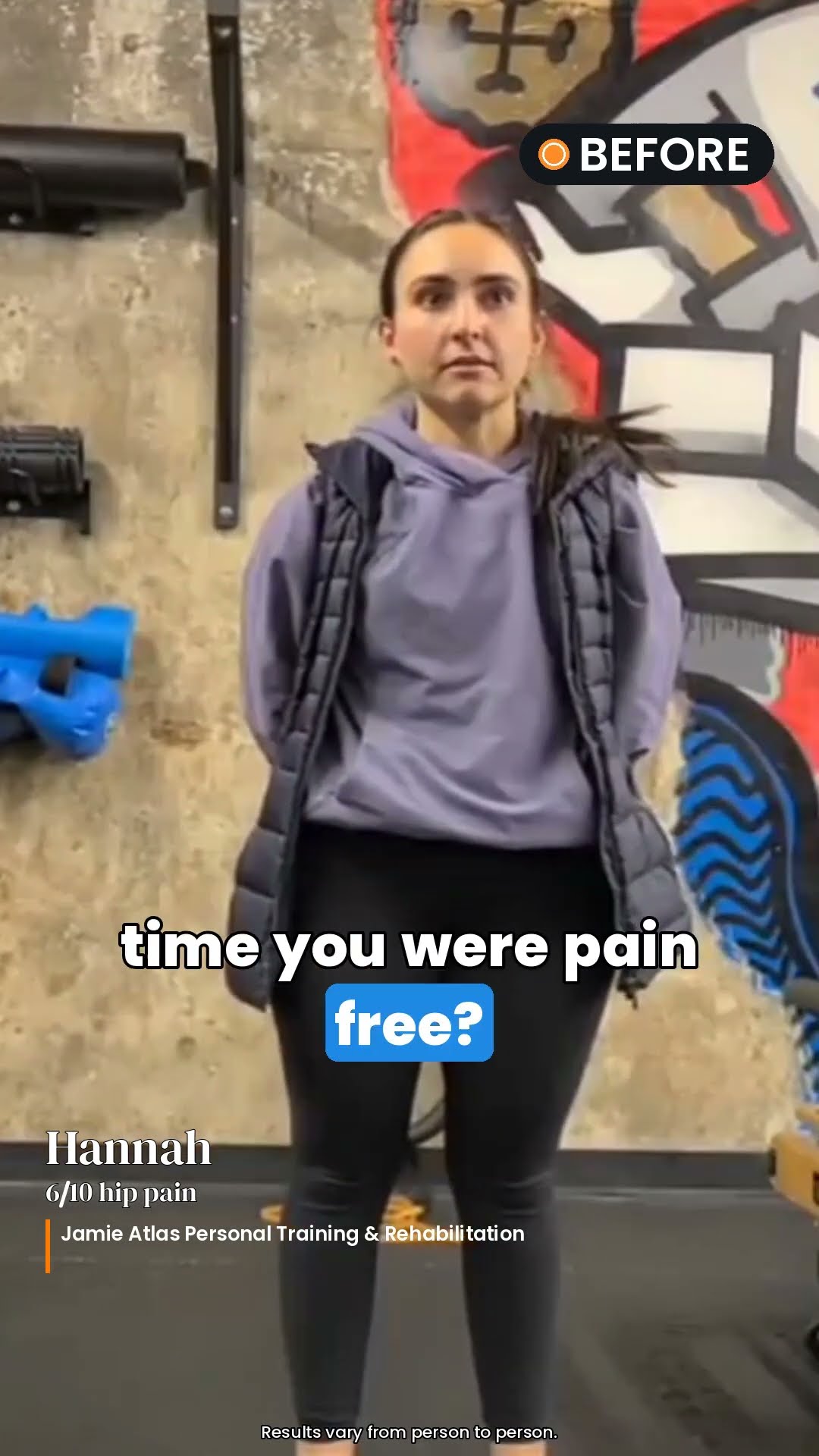 Play video: Hip Pain Relief in Denver: Hannah Went From 6/10 to Zero Pain in 55 Minutes
Book me in for my first session now
A 30-minute assessment session, $57, in the studio or on Zoom.
Getting out of the car. The sock on that side. The ache in the groin that arrives in the second hour of a hike, and the stiffness waiting on the stairs the next morning. You rested it, maybe had an injection, and at some point a scan came back with "degenerative" or "bone on bone" on it, the conversation turned to a replacement, and nobody explained what to do in the meantime. The meantime is where I work. A hip gets its tolerance back the same way the rest of you does, by being asked for a bit more than it managed yesterday and no more than it can take, and that's true on both sides of a surgery date.
In short: a hip that hasn't settled with rest usually does better with progressive strength work than with more rest. I start where your hip is today and build from there, one-on-one in downtown Denver, before a replacement, after one, or for the hips that never get as far as a surgeon.
Jamie Atlas, Personal Trainer & Rehabilitation Specialist · 6× 5280 Top of the Town winner · 2× Denver A-List winner · 9NEWS fitness expert
Rest worked, briefly, and that's what makes it so convincing, and so confusing
Rest settles the hip and shrinks it at the same time. While the joint calms down, the glutes and the muscles at the front and side of the hip get weaker, and the joint's own tolerance drops with them.
Then you go back to the stairs, the trail, the saddle. The demand is identical and your capacity is lower, so it flares, the obvious conclusion is more rest, and the loop tightens by one notch each time round.
I've watched people handle a sore hip the way my family handled the VCR in 1987: nobody touches it, and everyone waits for a child to come and make it work again. For about fifteen years I told people to work around the sore bit, hips included, and I said it with confidence. Isn't it a bit ridiculous that the standard plan for a joint you want to walk on was to stop asking it to do anything? The whole industry taught it, me included.
What breaks the loop is loading the hip at a dose it can handle today, then raising that dose on purpose until it clears what your week asks of it.
"Bone on bone" describes an X-ray, and it has ended more hikes than the arthritis has
What a hip looks like on film tracks poorly with how much it hurts and how well it works. Plenty of people with significant changes on an X-ray have little or no pain, plenty with mild changes hurt a great deal, and neither group is making it up.
Strength work reliably improves both pain and function in osteoarthritis, including the significant kind. The picture is a reason to start loading the leg properly, with someone reading the dose.
The fear that loading wears the joint out also points the wrong way. In the review I cite on the running pages, recreational runners had hip or knee arthritis at 3.5 percent against 10.2 percent in people who didn't run (Alentorn-Geli and colleagues, Journal of Orthopaedic & Sports Physical Therapy, 2017). It's a link rather than proof, and the dose matters, but it's a long way from "pounding ruins your hips."
If the report says labral tear or impingement instead, the same caution applies: plenty of people walk around with both on their scans and no hip pain at all. A finding on paper doesn't, on its own, tell us it's the reason you hurt, and it doesn't predict how well you'll do.
A replacement is a date on a calendar, and the months either side of it decide most of the outcome
I've trained clients on both sides of a hip replacement, in the months before the surgery and the months after it, and the two halves need different things.

Before. Most people are told to rest in the months before a hip replacement, which is the Rocky IV training montage run backwards: you arrive at the big day smaller than you started, and nobody wrote a song for that. The muscle you walk in with is the muscle you walk out on, so the job before surgery is to build whatever the hip will accept, inside whatever your surgeon has said. People who go in stronger tend to come out the other side faster.
After. The surgery goes fine, insurance physical therapy gets you up the stairs and back in the car, somebody writes "functional" on a form, and the visits run out. Most people come to me after that point, usually two to six months post-op. Wherever you are in it, I'll coordinate with your surgeon's protocol and add the pieces I think are low risk and high return, so your recovery is as fast as it can be.
Your surgeon sets the date for anything you want back, from the bike to the ski run, and I get you ready for it. Being signed off and being ready for a mogul field can be months apart, and that gap is where I do a lot of my work.
A short list belongs with a doctor before it belongs with me
It happened in a fall or in the last few weeks and you can't put weight on it. The joint is hot or swollen. Numbness around the groin or inner thighs, new trouble controlling your bladder or bowels, or weakness in the leg that's spreading. Fever alongside the pain. Those go to a physician first, and if I spot one in the assessment I'll say so instead of starting a plan.
Hip or groin pain in a runner over 45 that hasn't settled within a couple of weeks is also worth a proper look. Everything else, which is most of what walks in, is exactly the kind of case this work is built for.
The work starts above and below the hip, which surprises people
The hip is where it hurts. It's often where the bill arrives for something else, and it sends plenty of bills of its own: a hip that's lost rotation or extension hands the extra range to the lower back, and glutes that have gone quiet after years of sitting leave the knee below to pick up their share. Where it hurts and why it hurts are often two different places.
I use Cognitive Functional Therapy combined with Applied Functional Science, a system that identifies when the symptom and the cause of the pain are in different places, and how to use the whole body to create a different outcome than traditional methods. In plain words: we find what your hip will accept today, go back into the movements you stopped making without noticing, and make you strong there, because that's what makes the change stay.
The strength work takes angles seriously. Glute fibers wrap the hip at close to forty-five degrees, so straight-ahead squats and lunges leave a large share of the muscle untrained, and rotation and single-leg work reach the part that catches you on stairs and on ice.
Alongside that, a graded return to whatever the pain took: the full hike including the descent, getting in and out of the car without planning it, a night on that side, a day on your feet that doesn't cost you the evening. You keep moving the whole way through, modified where it needs to be, and most people are in the six to eight session range before they carry on under their own steam.
“Jamie has been my trainer for 3 1/2 years. I came to him as a 60 something woman who had never been on a workout routine. He has transformed me into a lean, mean work out machine. I am in the best shape of my life. He excels in targeted therapies. If your hip is giving you pain, he has specific exercises to relieve the pain. Joint or spine issues, he has a solution. My workouts address weight training for strength, balance, stretching and Pilates. He excels in creating individual work outs that give results. I highly recommend him as a trainer if you need rehabilitation or just need to get into shape.”
Susan Keicher, on Google
Common questions
Will walking, hiking or running wear my hip out faster?
No. The evidence leans the other way: in a 2017 review, recreational runners had hip or knee arthritis at 3.5 percent against 10.2 percent in people who didn't run. What causes trouble is doing too much too soon, so the dose is what we manage.
I'm scheduled for a hip replacement. Is there any point?
Yes, on both sides of it. The months before are when you build the muscle you'll walk out on, and the work after insurance physical therapy ends is where most people stall. You'll get a straight read on which side you're on at the first visit.
How soon after a hip replacement can I start?
Most people come to me after insurance physical therapy ends, usually two to six months post-op. Wherever you are, I'll coordinate with your surgeon's protocol and add the pieces I think are low risk and high return, so your recovery is as fast as it can be.
My scan says "bone on bone" or shows a labral tear. Doesn't that settle it?
It describes the picture, and the picture tracks poorly with how much a hip hurts or how well it works. Strength work improves both pain and function even in significant osteoarthritis, and the plan gets built around what your hip can do and relearn rather than around the report.
Can I keep hiking, riding or playing while we work on it?
Almost always yes, in a modified dose. Total rest is rarely the answer, and keeping you in your sport while the hip gets stronger is a goal of the plan rather than an afterthought.
How many sessions will I need?
Typically six to eight. You'll get a realistic estimate after the first assessment session rather than an open-ended commitment, and if your case needs a physician first, you'll hear that instead.
Why can it change this fast?
Pain is produced by your nervous system, not simply reported by your tissues. When pain outlasts healing, what usually keeps it going is a protection response: guarding, avoiding certain movements, a system that has learned to read ordinary load as danger. That's a learned pattern, and patterns can shift quickly when you give the system new information. Fast change proves the pain is changeable. Making it hold is the work that follows, and for most people that's six to eight sessions.
A quiet hip on the flat isn't the finish line
A hip that doesn't hurt on the walk to the car is a different thing from a hip you trust on a descent, in a saddle, or on the last day of a ski week. Closing that gap is strength training, and it's the work most people came for, whether or not they'd have said so at the start. If weight is part of the hip's story, the training and the food get handled together.
Related to this
-
A knee that hasn’t settled with rest
Knee pain, arthritis or a meniscus that didn't settle with rest or an injection. Strength work built around your knee, downtown Denver. $57 assessment session.
-
Your post-surgery recovery took you almost to the finish line. I get you the rest of the way, and then some
Insurance physical therapy got you to "functional." I get you back to skiing, cycling, lifting and running. One-on-one training after surgery in Denver.
-
Chronic back pain isn’t a life sentence
One-on-one training for chronic low back pain in downtown Denver, built on Cognitive Functional Therapy. For when physical therapy and injections haven’t held.
Find out if this is your way out
A 30-minute assessment session, $57: your story, my plain read on whether I can help, and one change you can measure before you leave.
Not in pain, just want to train hard without getting hurt? That's most of what I do →
Book me in for my first session nowOr call (303) 625-9446 · See how it works